
Abortion access is now easier in Europe thanks to a citizen’s campaign
Written by NADJA editors
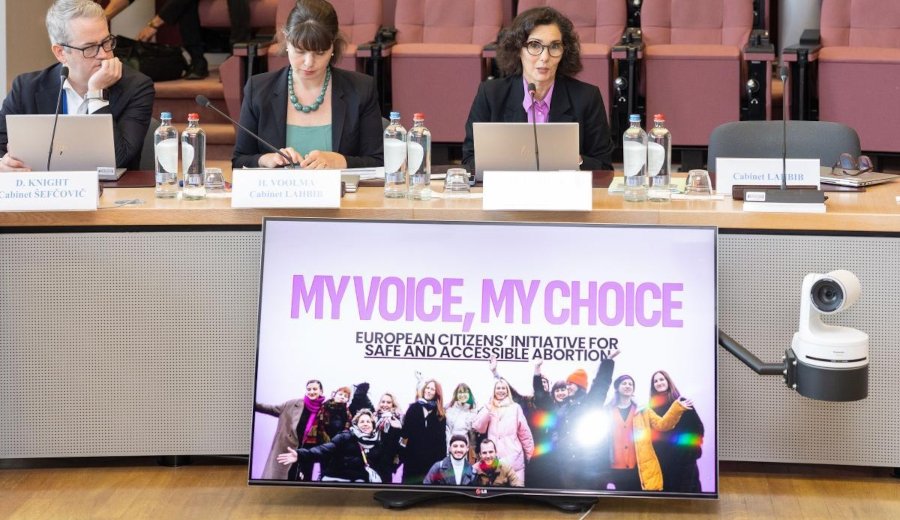
Photo: From right, Hadja Lahbib, European Commissioner for Equality; Halliki Voolma, member of her cabinet; and David Knight, policy assistant to European Commissioner for Interinstitutional Relations and Transparency Maroš Šefčovič. Source: European Union, 2025 / CC BY 4.0

- EU countries can now use a social fund to support cross-border travel for abortion services
- Abortion access varies widely across the EU, with strict laws and practical barriers in several countries
In March this year, the European Commission agreed to a landmark decision: that EU member states can provide funds to enable women to travel across borders to access safe, legal abortions, if the procedure isn’t possible in their country of residence.
The decision is the result of ‘My Voice My Choice’, a campaign put forward by the European Citizen’s Initiative. Under the scheme member states would opt in on a voluntary basis, and in return receive financial support from the EU. The agreement falls short of creating a new fund, instead drawing from the existing European Social Fund Plus (ESF+) that usually contributes to healthcare, education and social policies.
Women’s rights organisations have welcomed the decision, and European Equality Commissioner Hadja Lahbib said the decision would “change lives.”
“From now on, we are granting member states the possibility to use EU funding to improve access to abortion,” she said announcing the decision. “This is groundbreaking. This was only possible thanks to the Citizens’ Initiative, My Voice My Choice, with their one goal of safe and accessible abortion for women.”
Backlash to abortion rights
My Voice My Choice faced opposition from MEPs belonging to far right political parties and pro-life organisations. The proposal was submitted to the European Commission in September 2025, gathering more than 1.1 million signatures. During a European parliamentary session in December, MEPs widely endorsed the initiative voting in favour by 358 to 202, with 79 abstentions.
Campaigners also said they had been “silenced” by opposition efforts. “We are shadowbanned on social media. Anti-abortion organisations are doing everything in their power to stop us. We cannot let them win — but nothing we are trying is working,” they said via a social media post.
Abortion rights in the EU
In April 2024, the European Parliament voted in favour of including access to abortion in the European Union’s Charter of Fundamental Rights. However the vote was mostly symbolic, as securing a fully recognised right to abortion would require the approval of all 27 member states.
Access to abortion across the EU is patchy. While 25 countries allow abortion on request, many have time limits for the procedure. For example, in Belgium abortion is legal up to 12 weeks after conception, after which many women travel across the border to the Netherlands to terminate pregnancies. In Slovenia, Portugal and Croatia the time limit is 10 weeks, unless the pregnancy poses a serious risk to health.
Many countries also have a mandatory waiting period. In Germany an abortion can only be performed three days after a consultation, and after a government-approved counselling session.
Additionally, even in countries where abortion is legal, a significant number of doctors refuse to perform abortions citing moral objections.
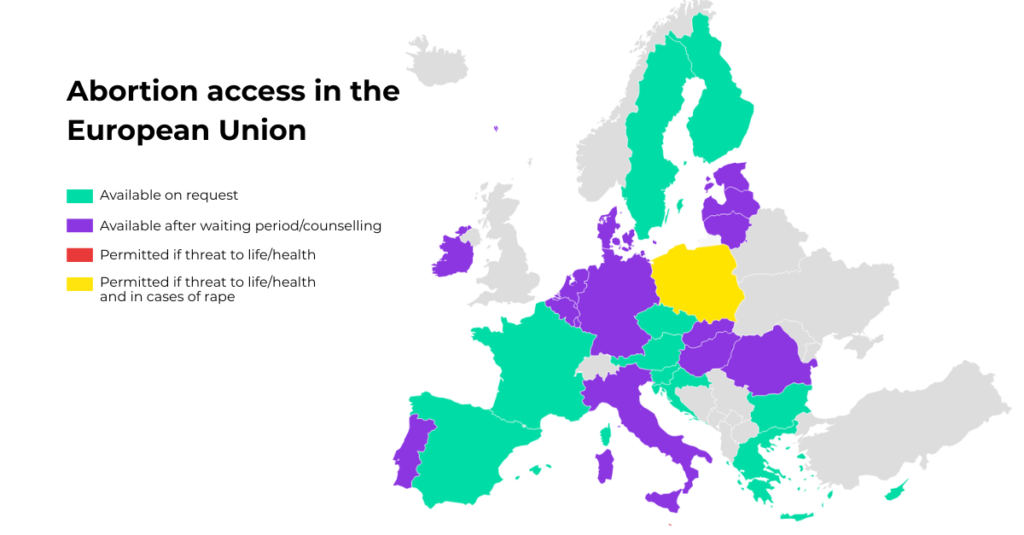
Poland and Malta have the most restrictive abortion laws in Europe. In Poland it is only permitted when the pregnancy poses a risk to health or life, or when it is the result of a criminal act like rape or incest. In Malta it is only legal in cases where it is a risk to life, and not in cases of rape.
Sweden and the Netherlands have the most permissive abortion laws. The Netherlands allows abortion on request up to the 24th week of pregnancy, the time when the foetus becomes viable outside the body.
France and Ireland have made recent changes to their legislation. In 2024 France enshrined the right to abortion in the French constitution, the first country in the world to do so. Ireland, where it was previously banned, now allows abortion on request up to the 12th week of pregnancy following a 2018 referendum.

READ MORE